There’s a quiet shift happening in how mental health is treated.
Not louder. Not flashy. Just… more layered.
People are starting to look beyond single solutions. And clinics like IV Solution & Ketamine Centers of Chicago reflect that shift. Ketamine therapy sits at the center. But around it, there are supporting treatments that don’t always get the same attention.
NAD+ infusion is one of them.
Not a headline treatment.
But not something to ignore either.
What Is NAD+ Infusion Therapy, Really?
NAD+ is a coenzyme your body already uses to produce energy and support brain function. Infusion therapy delivers it directly into the bloodstream for faster absorption.
NAD+ stands for nicotinamide adenine dinucleotide. It’s involved in cellular energy, DNA repair, and neurotransmitter activity. All the things that quietly keep the brain working.
Over time, levels drop. Stress, aging, poor sleep, chronic illness. It adds up.
An IV infusion bypasses digestion and delivers NAD+ directly into circulation. That’s the appeal. No delays. No guesswork about absorption.
Clinically, it’s not positioned as a cure. More like support. A way to stabilize systems that feel depleted.
And that matters more than it sounds.
How NAD+ Supports Mental Health
NAD+ may help regulate brain chemistry, improve energy metabolism, and support emotional stability, especially in people dealing with burnout or depression.
Mental health isn’t just about thoughts. It’s also about how the brain functions at a cellular level.
Low energy in the brain can show up as:
- fatigue that doesn’t go away
- difficulty concentrating
- emotional flatness
- slow recovery from stress
NAD+ plays a role in mitochondrial function. That’s the part of cells responsible for energy production. When that system struggles, everything feels heavier.
Some early research suggests NAD+ may support mood regulation and cognitive clarity. The National Institutes of Health has explored its role in neuroprotection and brain aging, though more clinical data is still evolving.
So no, it’s not a direct antidepressant.
But it can help create the conditions where improvement becomes possible.
Why NAD+ Is Often Paired With Ketamine Therapy
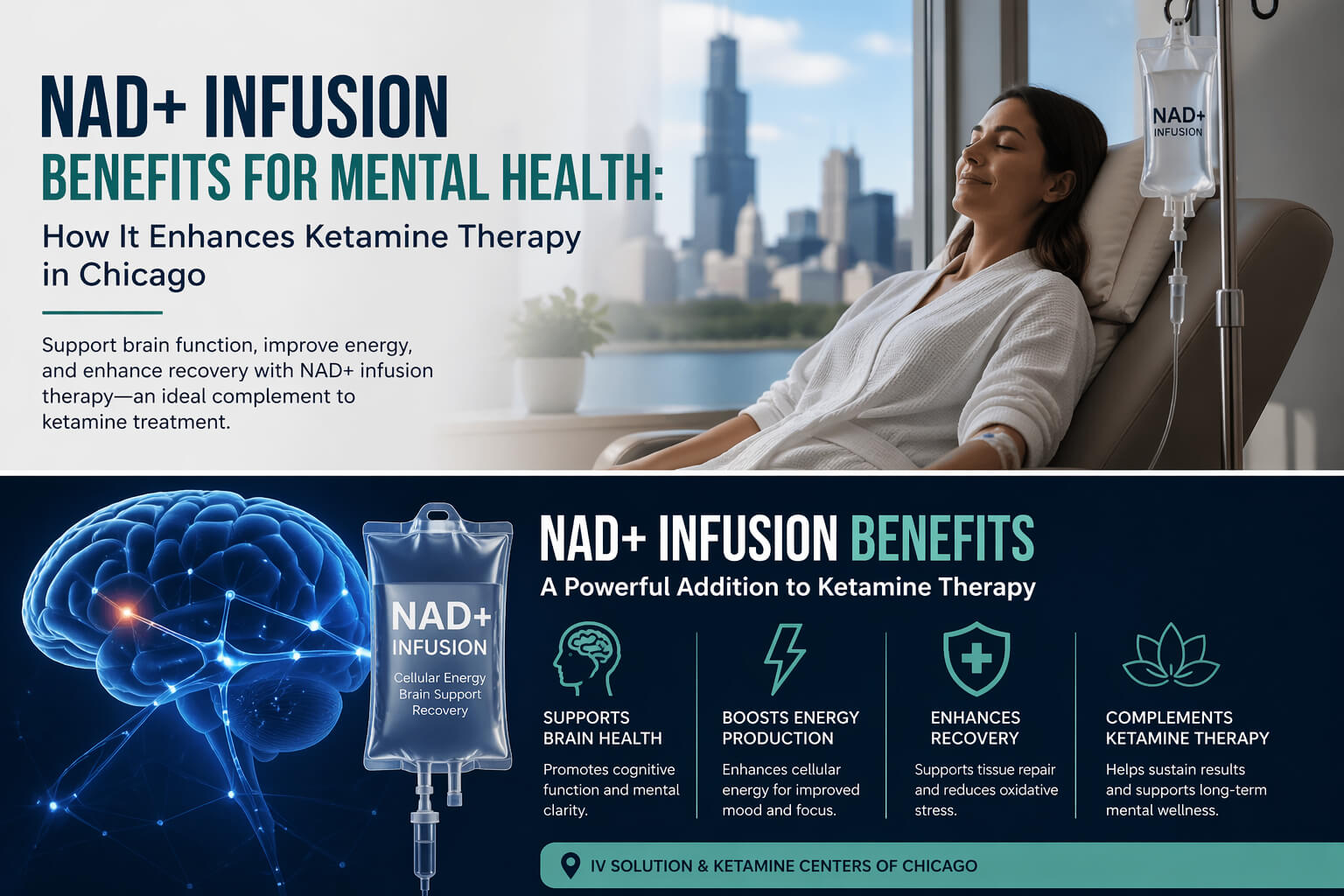
NAD+ doesn’t replace ketamine therapy. It supports it by improving brain function, recovery, and resilience between sessions.
Ketamine works differently. It targets glutamate pathways and helps the brain form new neural connections. For many people, that’s where the shift begins.
But what happens after the session?
That’s where support matters.
NAD+ can:
- help reduce mental fatigue after infusions
- support cognitive clarity during treatment cycles
- improve overall energy levels
- assist in stabilizing mood between sessions
Think of it less as a treatment and more as reinforcement.
Ketamine opens the door. NAD+ helps the brain walk through it without collapsing halfway.
This is especially relevant in structured programs like addiction recovery, where both mental clarity and physical resilience are needed over time.
Can NAD+ Improve Ketamine Therapy Results?
It may enhance overall outcomes by supporting recovery, but it doesn’t directly increase ketamine’s effectiveness.
There’s no strong clinical claim that NAD+ makes ketamine “work better” in a direct sense.
What it can do is reduce friction.
That’s often overlooked.
When the brain has more energy, when fatigue is lower, and when cognitive function improves
even slightly, patients are more likely to:
- Engage with therapy
- Process emotional experiences
- Stay consistent with treatment
And consistency changes outcomes.
Some clinics integrate NAD+ as part of a broader care plan rather than offering it as a standalone service. This layered approach is becoming more common, especially in centers focused on long-term mental health rather than quick fixes.
Safety and Side Effects of NAD+ Infusions
NAD+ infusions are generally well-tolerated when administered in a medical setting, but mild side effects can occur.
Most people handle NAD+ infusions without major issues. Still, it’s not completely neutral.
Possible side effects include:
- nausea
- chest tightness during infusion
- mild headache
- fatigue immediately after
These effects are usually temporary and often managed by adjusting the infusion rate.
Medical supervision matters here. This isn’t something to approach casually or through unverified providers.
The U.S. Food and Drug Administration does not specifically approve NAD+ infusions as a treatment for mental health conditions, which is why it’s typically offered as a complementary therapy rather than a primary one.
Who Should Consider NAD+ Infusion Therapy?
NAD+ may be useful for people experiencing mental fatigue, burnout, or those undergoing structured treatments like ketamine therapy.
It tends to make sense for people who:
- Feel physically and mentally depleted
- Struggle with low energy alongside depression or anxiety
- They are already undergoing ketamine therapy
- Are in recovery from substance use
It’s less relevant for someone looking for a quick boost or a one-time solution.
There’s a difference between optimization and treatment. NAD+ sits somewhere in between.
Cost and Practical Considerations
NAD+ infusions are typically out-of-pocket and vary in cost depending on dosage and treatment plans.
Pricing can vary widely depending on the clinic and protocol. Sessions are often priced per infusion, and some programs bundle them with broader treatment plans.
A few things to consider:
- Multiple sessions may be recommended
- Infusion time can be longer than standard IV therapies
- Results are gradual, not immediate
For those already investing in ketamine therapy, NAD+ is often considered an add-on rather
than a standalone expense.
Where It Fits in the Bigger Picture
NAD+ is not a primary treatment, but it can play a meaningful supporting role in a comprehensive mental health plan.
Mental health care is rarely linear.
Some treatments create breakthroughs. Others help sustain them.
NAD+ seems to fall into the second category.
Quiet support. Subtle shifts. Less dramatic, but still important.
And for many people, especially those navigating deeper or long-standing challenges, that kind of support can make the difference between temporary improvement and something that lasts.
There’s a tendency to look for one solution. One answer. One treatment that fixes everything.
But most people already know it doesn’t work like that.
Real progress tends to come from layers.
From combining the right approaches at the right time.
Ketamine therapy may open new pathways.
NAD+ helps the brain keep up with the change.
Not flashy.
But quietly useful.