
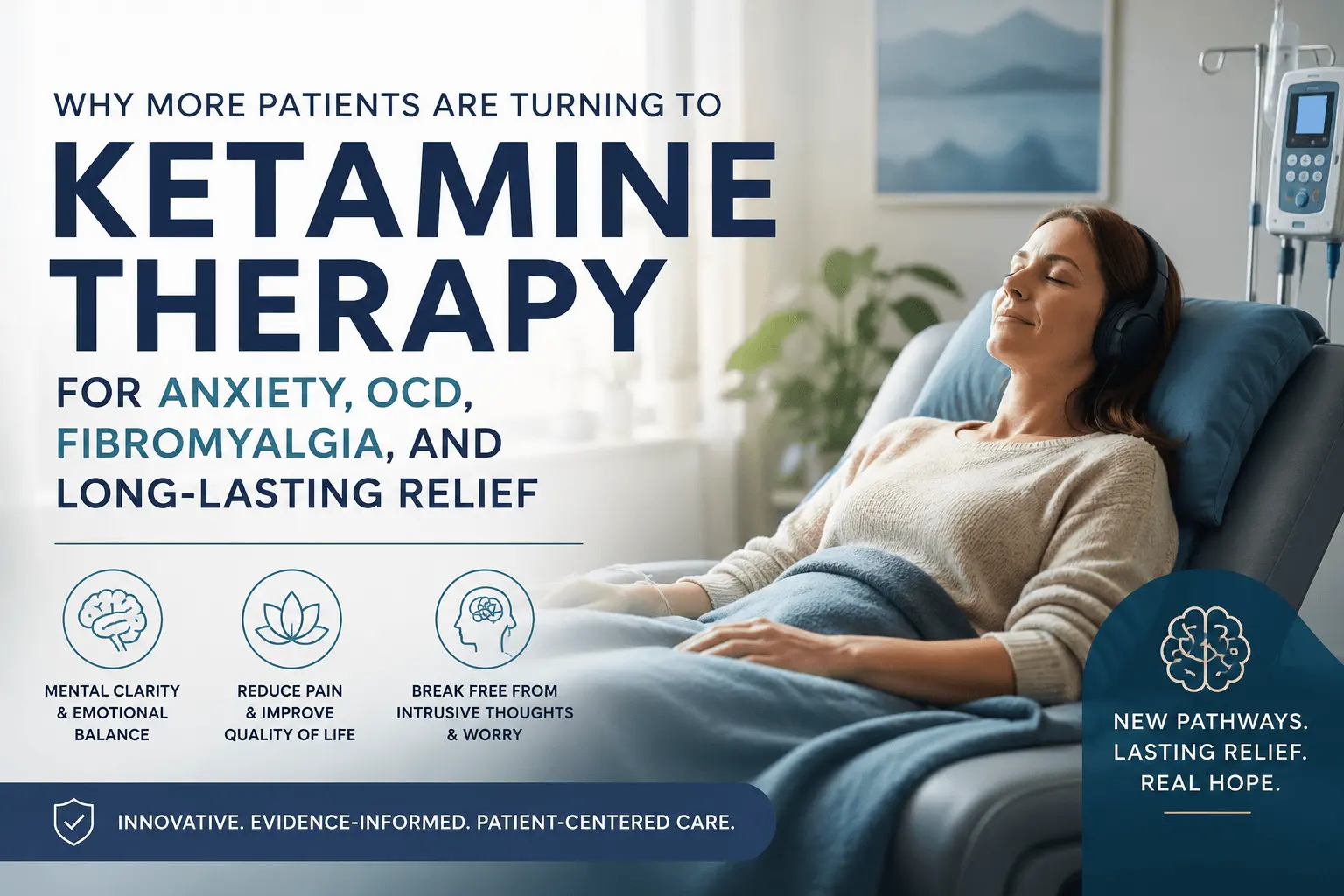
There’s a particular kind of exhaustion that doesn’t always show up on scans or bloodwork. It lives in routines that slowly shrink. In the way someone starts saying “maybe next time” to plans they once looked forward to. In the quiet calculations before getting out of bed.
People dealing with anxiety, OCD, or fibromyalgia often become experts at functioning while struggling. That part is easy to miss from the outside. The job still gets done. The groceries still get bought. Texts still get answered, eventually. But underneath it, sometimes for years, the nervous system just keeps burning.
And that may be part of why conversations around ketamine therapy have changed so dramatically over the last few years. What was once treated as fringe or misunderstood is now
being studied in major medical institutions and explored by patients who have already tried…
well, almost everything else.
Not because people are looking for shortcuts.
Usually, it’s the opposite.
What Makes Ketamine Therapy Different From Traditional Treatment?
Ketamine appears to work on different pathways in the brain than many traditional medications.
That matters more than it sounds.
Conventional antidepressants and anti-anxiety medications often target serotonin or similar neurotransmitters. Helpful for many people, certainly. But not always enough, especially for individuals dealing with treatment-resistant symptoms or chronic nervous system dysregulation.
Ketamine therapy works differently by influencing glutamate activity, which researchers believe may help promote new neural connections and improve brain flexibility over time. The science is
still evolving, carefully and slowly, as good science tends to do. But the clinical interest is real.
According to the Yale School of Medicine, ketamine has shown promising effects for treatment-resistant depression and related mental health conditions. The National Institute of Mental Health has also continued expanding research into rapid-acting therapies for severe mood disorders.
And then there’s the human side of it. The part harder to quantify.
Some patients describe feeling mentally “unstuck” for the first time in years. Others notice that the constant loop of intrusive thinking softens just enough to breathe differently again. Not magically. Not overnight forever. But enough to create movement.
Sometimes movement is the beginning.
Ketamine Therapy for Anxiety Isn’t Just About Feeling Calm
That’s an important distinction.
People often imagine anxiety as panic or obvious fear. But chronic anxiety can become strangely physical over time — tension headaches, digestive problems, racing thoughts at 2 a.m., difficulty resting even during quiet moments.
The body adapts to stress until stress starts feeling normal.
Ketamine infusion therapy is increasingly being explored for persistent anxiety symptoms, especially when traditional medications or therapy alone haven’t provided enough relief. Some individuals report improvements in emotional flexibility, sleep quality, and nervous system regulation after a series of treatments.
Not every patient responds the same way. That deserves honesty.
Still, the growing interest in ketamine therapy for anxiety reflects something deeper happening in healthcare right now: a recognition that mental health treatment sometimes requires broader approaches, especially when symptoms have become chronic or deeply ingrained.
And anxiety often does become ingrained. Quietly.
A person can forget what “calm” even used to feel like.
Can Ketamine Therapy Help OCD Symptoms?
For some patients, yes — particularly those dealing with intrusive thoughts that remain persistent despite conventional treatment.
Obsessive-compulsive disorder is frequently misunderstood because the visible compulsions are only part of the experience. The exhausting part is often internal. Endless checking.
Replaying conversations. Mental rituals. Fear spirals that refuse to loosen their grip, no matter how irrational they seem logically.
Logic alone rarely solves OCD. Anyone who has lived near it understands that.
Research into ketamine therapy for OCD is still developing, but early findings have generated cautious optimism within psychiatric medicine. Some clinicians believe ketamine’s effects on
neural connectivity and cognitive flexibility may help interrupt rigid thought patterns associated with OCD.
That possibility matters because many OCD patients spend years cycling through medications, therapy modalities, and coping strategies before finding meaningful relief.
And honestly, the fatigue from trying can become its own burden.
At clinics offering mental health-focused ketamine treatments, evaluations are typically individualized, taking into account symptom history, medication response, and overall health. Which is how it should be. Thoughtful care tends to work better than one-size-fits-all promises.
Fibromyalgia Changes More Than Just Pain Levels
People with fibromyalgia often become skilled at minimizing their own experience because explaining it repeatedly becomes exhausting.
The pain moves. Energy disappears unpredictably. Brain fog interrupts conversations midway through sentences. Some days feel almost normal, and then suddenly not at all.
That unpredictability can wear people down emotionally in ways outsiders rarely understand.
Ketamine therapy for fibromyalgia has gained attention partly because of ketamine’s interaction with pain-processing pathways in the nervous system. Certain studies suggest it may help reduce central sensitization — essentially, the nervous system remaining stuck in an amplified pain state.
Again, not a miracle cure. Probably important to say that clearly.
But for some individuals living with chronic pain conditions, ketamine therapy may create enough reduction in symptom intensity to improve daily functioning, sleep, or emotional resilience. Sometimes that shift alone changes the quality of life more than expected.
Interestingly, many chronic pain patients describe something beyond physical relief after treatment. A softening. Less internal bracing against the day ahead.
That emotional layer of chronic illness often gets overlooked in medical conversations. Yet it’s there constantly.
How Long Does Ketamine Therapy Last?
This is usually the question people ask quietly after reading everything else.
And the honest answer is: it varies.
Some patients notice benefits lasting weeks after an initial treatment series. Others pursue maintenance sessions periodically, especially when managing chronic conditions like severe anxiety, PTSD, depression, or fibromyalgia.
Factors that may influence duration include:
- The condition being treated
- Symptom severity
- Overall nervous system health
- Sleep and stress levels
- Ongoing therapy or lifestyle support
- Frequency of maintenance infusions
For many clinics, the goal isn’t simply temporary symptom suppression. It’s helping create a larger treatment window where patients can engage more effectively with therapy, relationships,
routines, and everyday life.
That distinction matters.
Because healing rarely comes from one thing alone. More often, it’s layers of support finally working together after years of surviving in fragments.
Patients exploring ketamine treatment consultations often want certainty before starting. Understandably. But medicine — especially nervous system medicine — doesn’t always offer certainty. What it can offer is possibility, careful evaluation, and sometimes a treatment path that feels different from what has already failed.
And for many people, that possibility becomes worth exploring.
A Different Kind of Conversation Around Mental Health and Pain
There’s been a noticeable shift recently in how people talk about chronic mental health struggles and pain disorders. Less shame. Less pretending. More honesty about how difficult it can be to
function while carrying invisible symptoms for years.
That shift may be one reason ketamine therapy continues gaining attention across anxiety care, OCD treatment, and chronic pain management.
Not because it’s trendy.
Mostly because people are tired. Tired of feeling trapped inside symptoms that never fully quiet down. Tired of treatments that almost help but not quite enough. Tired of measuring life around
limitations.
And sometimes, cautiously, carefully, something new opens a door.
Not all at once. Rarely dramatically. But enough to imagine a future that feels a little less narrow than before.
Still wondering whether ketamine therapy could be the right fit for anxiety, OCD, fibromyalgia, or persistent symptoms that haven’t responded to traditional treatment? Sometimes, the most
helpful next step is simply having an honest conversation with someone who understands how layered these conditions can become over time.
If you’d like to explore whether treatment could make sense for your situation, reach out to the team at Chicago IV Solution for a confidential consultation and learn more about personalized
ketamine therapy options.