
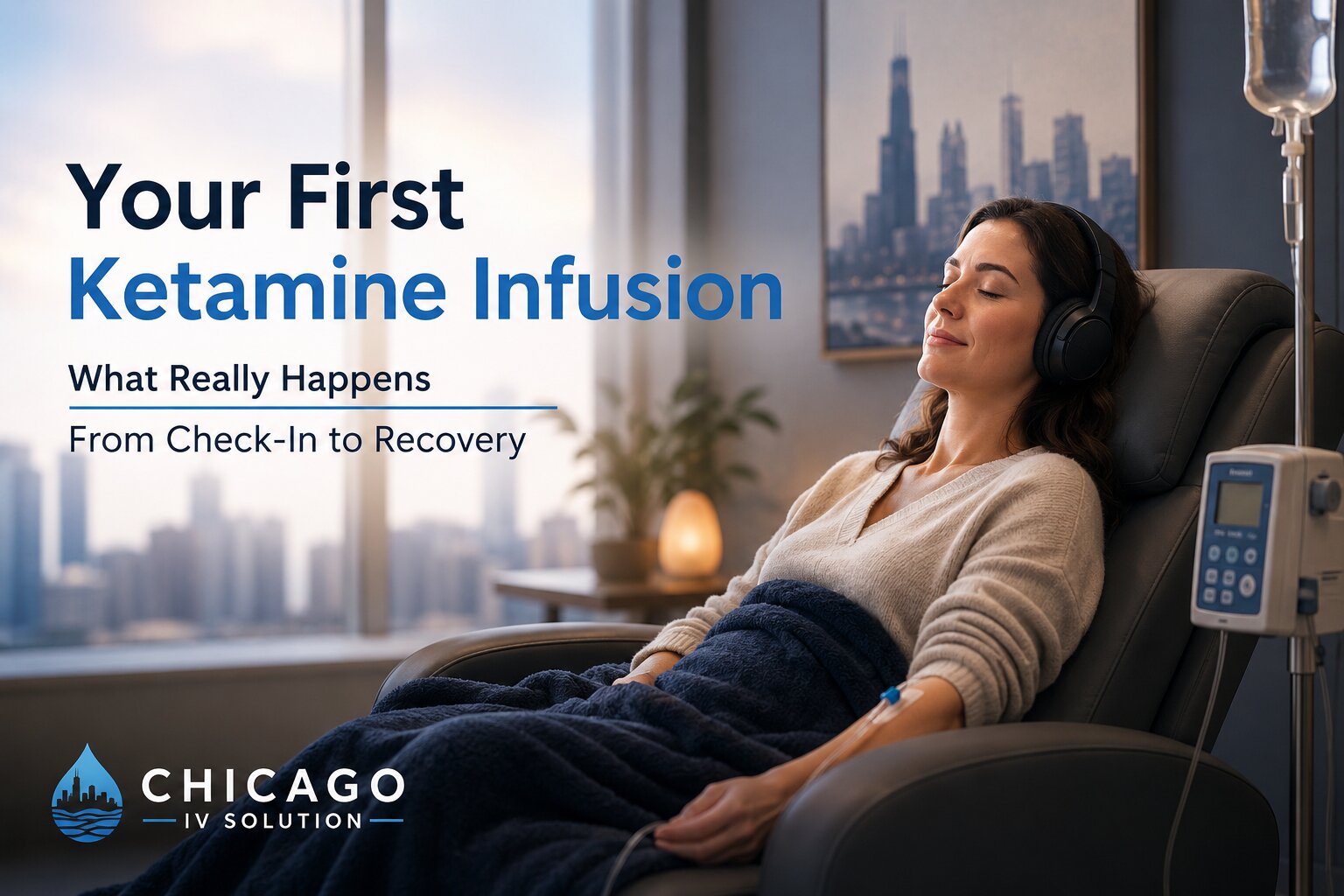
The days leading up to a first ketamine infusion are often filled with quiet questions. That’s completely normal. When a treatment is unfamiliar, it’s natural to wonder what the experience will actually be like, and whether it will feel as intimidating as it sounds.
Will it feel strange? Will someone stay with me? What if it doesn’t work? What if it does?
For many people considering ketamine therapy, those questions are completely understandable. Most have already spent months, or even years, trying medications, therapy, or other treatments without finding the relief they hoped for. Walking into something new can feel equal parts hopeful and intimidating.
The good news is that what to expect during ketamine infusion therapy is often far less overwhelming than people imagine. The experience is carefully monitored, personalized, and designed with patient comfort in mind.
Knowing what happens before, during, and after treatment won’t eliminate every nervous thought. But it often replaces uncertainty with something much more useful: confidence.
Before You Arrive: Preparation Is Simpler Than Most People Expect
The short answer? Preparation usually involves following your provider’s instructions, wearing comfortable clothing, arranging transportation home, and arriving with an open conversation about your health history.
Before treatment begins, your medical team reviews medications, previous treatments, symptoms, and overall health to determine whether IV ketamine therapy is appropriate. That evaluation matters because ketamine isn’t a one-size-fits-all solution. The safest, most effective treatment plans are individualized.
At Chicago IV Solution, patients begin with a consultation that helps determine whether ketamine therapy or another treatment, such as Stellate Ganglion Block (SGB) for PTSD, may be the better fit. The goal isn’t simply scheduling an infusion—it’s making sure the treatment aligns with the patient’s needs. Find Out More: Chicago IV Solution.
Comfortable clothes are usually recommended. Heavy meals immediately beforehand may not be.
And perhaps the most important preparation? Permitting yourself not to know everything before walking through the door.
Check-In Isn’t Rushed, It’s Designed to Help You Settle In
Many first-time patients imagine a busy medical office with constant activity. Instead, most ketamine clinics intentionally create a quieter environment.
After check-in, vital signs are recorded, paperwork is reviewed if needed, and there is time to ask last-minute questions. Nothing about this part should feel hurried.
That pause matters more than people sometimes realize.
Anxiety has a way of filling silence with worst-case scenarios. A calm conversation with the medical team often changes the emotional tone of the entire appointment.
Meeting Your Care Team Is Part of the Treatment Experience
One thing that surprises many patients is how much interaction happens before the infusion even begins.
The physician or nurse reviews the treatment plan, discusses what sensations may occur during the infusion, and explains how monitoring will work throughout the session.
Questions are encouraged. Actually, they’re expected. People frequently ask things like:
- Will I fall asleep?
- Can I listen to music?
- Will I remember the experience?
- What if I become anxious?
Those conversations aren’t interruptions to care. They’re part of good care.
What Happens During the Ketamine Infusion?
The infusion itself is generally straightforward.
An IV is placed, and ketamine is administered slowly over a prescribed period, allowing the medical team to carefully monitor both comfort and response. Throughout the treatment, heart rate, blood pressure, and oxygen levels are observed while trained clinicians remain available if anything feels uncomfortable. Explore Your Options at Chicago IV Solution.
Many patients choose to close their eyes. Others listen to calming music.
Some simply rest.
Experiences vary considerably.
Some people describe feeling deeply relaxed. Others notice changes in perception, time, or awareness. A few report vivid thoughts or dreamlike imagery. These effects are generally temporary and expected during treatment.
Interestingly, many patients spend weeks worrying about the infusion itself, only to discover that the anticipation was far more stressful than the appointment.
Is Ketamine Infusion Therapy Safe?
When performed in an appropriately supervised medical setting, ketamine therapy has an established safety profile for carefully selected patients.
That supervision is an important part.
Medical professionals monitor vital signs throughout treatment and adjust care when necessary. Clinics also screen for conditions or medications that could affect whether ketamine is an appropriate option.
Like many medical treatments, ketamine can produce temporary side effects. These may include:
- Mild dizziness
- Nausea
- Temporary increases in blood pressure
- Blurred vision
- Fatigue after treatment
- Dissociation or altered perception during the infusion Most effects gradually resolve shortly after the session
Organizations such as the American Psychiatric Association emphasize that ketamine treatment should occur under medical supervision using appropriate patient selection and monitoring protocols.
Learn more from the American Psychiatric Association: www.psychiatry.org.
Recovery Usually Feels Quiet Rather Than Dramatic
Recovery begins almost immediately after the infusion finishes.
Patients typically remain at the clinic for observation while the immediate effects wear off. Some people feel calm.
Others feel emotionally reflective.
Occasionally, someone simply feels tired enough to want a long nap. That range is perfectly normal.
Because alertness may remain temporarily affected, driving afterward isn’t recommended. Having a trusted family member or friend provide transportation home allows patients to focus entirely on recovery.
Many clinics encourage taking the remainder of the day slowly. No packed schedules.
No major decisions.
Just space to let both mind and body settle.
When Will You Notice Results?
This is probably the question patients ask most often. The honest answer is that everyone responds differently.
Some individuals notice improvements within hours or days. Others experience gradual changes over several treatments.
Relief doesn’t always arrive dramatically. Sometimes it appears quietly.
A little more motivation to get out of bed.
A conversation that feels easier than it did last week. Sleeping through the night for the first time in months. Those small changes can become meaningful milestones.
Research supported by the National Institute of Mental Health (NIMH) continues to explore ketamine’s rapid effects for treatment-resistant depression and other mental health conditions, although long-term care plans should always be individualized.
More information is available through the National Institute of Mental Health: www.nimh.nih.gov.
What Happens After the First Infusion?
The first appointment is rarely the entire treatment plan.
For many conditions, ketamine therapy involves an initial series of infusions followed by ongoing evaluation. Depending on the condition being treated and how symptoms respond, some patients may eventually benefit from maintenance treatments.
That’s another reason communication matters. The goal isn’t simply completing infusions.
It’s understanding how symptoms change over time and adjusting care accordingly.
Chicago IV Solution also offers additional evidence-based options, including SGB therapy for PTSD, allowing patients to receive care that reflects their individual diagnosis rather than forcing everyone into the same protocol. (Chicago IV Solution)
The Biggest Surprise? Most People Leave Wondering Why They Waited So Long
Fear tends to imagine the unknown as something much larger than it usually is.
The first ketamine infusion is certainly a new experience. But it isn’t meant to feel frightening. It’s meant to feel safe.
Supported. Thoughtfully guided.
That doesn’t guarantee every patient will have the same outcome. Medicine rarely works that way. But understanding the process ahead of time allows people to walk into treatment with fewer unanswered questions and a little more peace of mind.
Sometimes that’s the first meaningful step toward healing.
Frequently Asked Questions
How long does a ketamine infusion appointment take?
Most appointments include check-in, preparation, the infusion itself, and a recovery period. Your provider will explain the expected timeline during your consultation.
Can I eat before ketamine therapy?
Your medical team will provide personalized instructions. Following those recommendations helps improve comfort during treatment.
Will I be awake during the infusion?
Most patients remain awake but deeply relaxed. Experiences vary, and your care team monitors you throughout the session.
Is one infusion enough?
Some patients notice early improvements after one treatment, while many benefit from a series of infusions based on their condition and treatment goals.
Ready to Learn Whether Ketamine Therapy Is Right for You?
If you’ve been living with depression, PTSD, anxiety, or chronic pain that hasn’t improved with conventional treatment, the next step doesn’t have to be taken alone.
Schedule a free consultation with the experienced medical team at Chicago IV Solution to discuss your symptoms, ask questions, and explore whether personalized ketamine therapy or SGB treatment may be appropriate for you.
Helpful resources:
- Ketamine for Mental Health: com/kmh
- Explore All Treatment Options: com/our-treatments
- Veterans Program: com/vets
- Schedule a Consultation: com/ (Chicago IV Solution)